
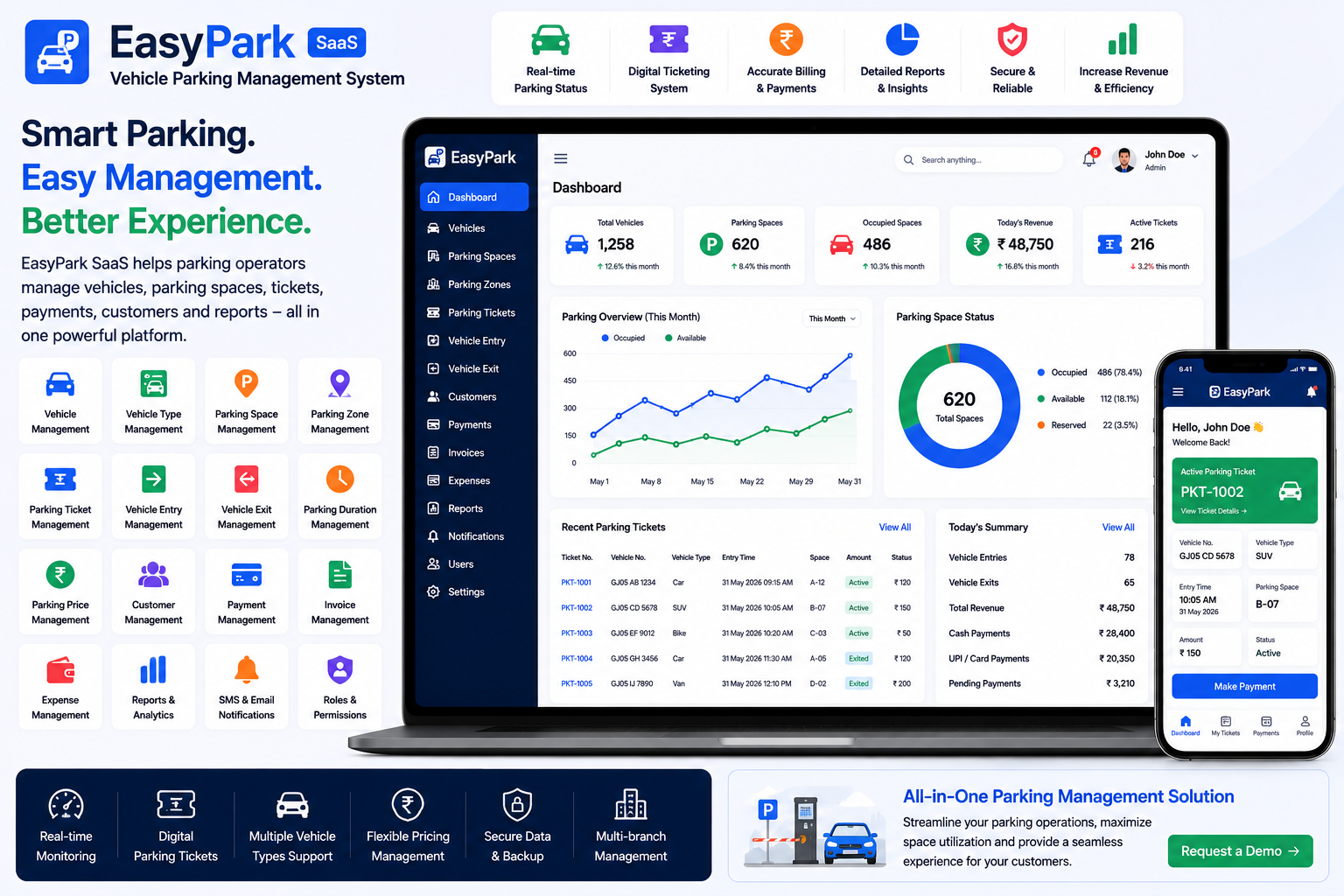
Looking for a ready-made solution?
👉Vehicle Parking Management System
https://smartwebinfotech.com/items/easypark-saas-vehicle-parking-management-system/1010
Managing a parking facility can become challenging when the number of vehicles, parking spaces, customers, and transactions increases. Traditional paper registers and manual parking tickets make it difficult to track vehicle entry and exit, monitor available spaces, calculate parking charges, and maintain accurate payment records.
A Vehicle Parking Management System provides a centralized digital solution for managing parking operations, vehicle records, parking spaces, customers, tickets, payments, and reports.
Whether you operate a commercial parking facility, residential parking area, shopping center, office complex, hospital, hotel, or private parking business, parking management software can help streamline daily operations.
In this guide, we'll explore what a Vehicle Parking Management System is, its key features, benefits, use cases, and how EasyPark SaaS can help businesses modernize their parking operations.
What Is a Vehicle Parking Management System?
A Vehicle Parking Management System is software designed to help parking operators manage vehicles, parking spaces, parking tickets, customers, entry and exit records, payments, and parking-related activities.
A typical parking workflow can look like:
Vehicle Entry → Parking Space Assignment → Parking Ticket → Parking Duration → Vehicle Exit → Payment → Parking Space Available
Instead of relying on paper tickets and manual registers, parking operators can manage this workflow digitally.
EasyPark SaaS – Vehicle Parking Management System is designed to help businesses manage parking operations through a centralized platform.
Why Do Parking Businesses Need Parking Management Software?
Manual parking management can create several operational problems.
Common challenges include:
- Difficulty tracking available parking spaces
- Manual vehicle entry records
- Lost parking tickets
- Incorrect parking charges
- Difficulty monitoring vehicle exits
- Manual payment records
- Poor customer information management
- Difficulty generating reports
- Lack of real-time parking visibility
- Increased administrative workload
A digital parking management system can help address these challenges by bringing parking operations into one centralized platform.
Key Features of a Vehicle Parking Management System
1. Informative Parking Dashboard
A centralized dashboard gives parking operators an overview of their parking business.
Instead of checking multiple registers, staff can access important information from one place.
A parking dashboard can help monitor:
- Vehicles
- Parking Spaces
- Parking Tickets
- Customers
- Payments
- Income
- Expenses
- Parking Activity
This provides better visibility into daily parking operations.
2. Vehicle Management
Vehicle information is a fundamental part of parking management.
A vehicle management module can maintain:
- Vehicle Number
- Vehicle Type
- Vehicle Owner
- Contact Information
- Entry Information
- Exit Information
- Parking History
This makes it easier to identify vehicles and maintain their parking records.
3. Vehicle Type Management
Different vehicles may require different parking spaces and pricing.
For example:
- Motorcycle
- Car
- SUV
- Van
- Truck
- Bus
- Commercial Vehicle
Vehicle type management allows parking operators to organize vehicles according to their category.
This can also help define different parking prices.
4. Parking Space Management
Efficient space management is one of the most important parts of a parking system.
A parking space management module helps operators organize available parking areas.
Parking spaces can be categorized according to:
- Parking Zone
- Floor
- Section
- Space Number
- Vehicle Type
- Availability Status
This makes it easier to identify which spaces are available or occupied.
5. Parking Zone Management
Large parking facilities may have multiple zones.
For example:
Zone A → Cars
Zone B → Motorcycles
Zone C → VIP Parking
Zone D → Commercial Vehicles
Zone management can help operators organize parking spaces and manage larger facilities more efficiently.
6. Parking Ticket Management
Parking tickets provide a record of vehicle parking activity.
A digital parking ticket can contain:
- Vehicle Number
- Vehicle Type
- Entry Time
- Parking Space
- Customer Information
- Parking Duration
- Parking Charges
- Ticket Status
This makes the parking process more organized and reduces dependence on paper tickets.
7. Vehicle Entry Management
Vehicle entry is the beginning of the parking process.
The system can record important entry information such as:
- Vehicle
- Entry Time
- Customer
- Parking Space
- Parking Ticket
- Vehicle Type
Digital entry records make it easier to track vehicles currently inside the parking facility.
8. Vehicle Exit Management
When a vehicle leaves the parking facility, the system can update its parking status and calculate the relevant charges.
The exit process can include:
Parking Ticket → Entry Time → Exit Time → Parking Duration → Parking Fee → Payment → Exit
Once the vehicle exits, the parking space can become available for another vehicle.
9. Parking Duration Management
Parking fees are often calculated according to the amount of time a vehicle stays in the facility.
For example:
- Hourly Parking
- Daily Parking
- Monthly Parking
- Custom Duration
A digital system can make it easier to maintain parking duration records and calculate charges according to configured rules.
10. Parking Price Management
Different vehicle types or parking zones may require different pricing.
Parking operators can define pricing according to their business model.
For example:
Vehicle
Pricing Model
Motorcycle
Hourly
Car
Hourly
SUV
Hourly
Commercial Vehicle
Daily
Monthly Customer
Monthly
Configurable pricing makes it easier to adapt the system to different parking businesses.
11. Customer Management
Parking businesses may have regular customers, monthly subscribers, corporate customers, and occasional visitors.
Customer management can maintain:
- Customer Name
- Contact Details
- Vehicle Information
- Parking History
- Payments
- Subscription Information
- Notes
This can help businesses provide better service to repeat customers.
12. Parking Payment Management
Payment management is essential for any parking business.
A parking management system can maintain:
- Parking Charges
- Payment Amount
- Payment Date
- Payment Method
- Payment Status
- Customer
- Parking Ticket
Digital payment records make financial tracking easier.
13. Invoice Management
Businesses that provide parking services to corporate or long-term customers may require invoices.
Invoice management can help generate and maintain professional billing records.
Invoices may contain:
- Customer
- Vehicle
- Parking Service
- Duration
- Charges
- Taxes
- Discounts
- Total Amount
- Payment Status
14. Expense Management
Parking facilities have operating expenses such as:
- Staff Salaries
- Electricity
- Security
- Maintenance
- Cleaning
- Equipment
- Rent
- Facility Repairs
Expense management helps parking operators track these costs and understand overall business performance.
15. Income & Expense Reports
Reports provide useful information about the financial performance of a parking business.
Management can analyze:
- Parking Income
- Payments
- Expenses
- Transactions
- Revenue Trends
This can help owners understand profitability and make better business decisions.
16. Parking History
Maintaining parking history is useful for both operational and customer service purposes.
A digital history can show:
- Vehicle
- Entry Date
- Exit Date
- Parking Duration
- Parking Space
- Charges
- Payment
This information can be searched more easily than paper records.
17. User Roles & Permissions
Different employees may require different access levels.
For example:
- Super Admin
- Parking Manager
- Parking Staff
- Customer
Role-based permissions allow administrators to control access to different modules and functions.
This is particularly useful for larger parking facilities with multiple employees.
18. Customer Dashboard
A customer dashboard can provide customers with access to relevant parking information.
Depending on the system configuration, customers may be able to view:
- Parking Information
- Vehicle Information
- Parking History
- Payments
- Account Details
A customer-facing portal can improve transparency and reduce the need for manual support.
19. Notifications
Digital notifications can help parking operators communicate important information.
Notifications can potentially be used for:
- Parking Confirmation
- Payment Confirmation
- Subscription Updates
- Parking Expiry
- Customer Communication
Automated notifications can improve the overall customer experience.
20. SMS & Communication Integration
Parking businesses may need to communicate with customers through digital channels.
SMS integration can be useful for:
- Parking Updates
- Payment Notifications
- Membership Expiry
- Customer Alerts
Depending on the configuration, SMS and other communication integrations can help automate customer notifications.
21. Subscription & Monthly Parking
Some parking businesses offer monthly or recurring parking plans.
Examples include:
- Monthly Parking
- Corporate Parking
- Resident Parking
- Employee Parking
- VIP Parking
Subscription management can help businesses maintain recurring parking customers and manage their plans.
22. Reports & Analytics
A good parking management system should provide useful operational reports.
Reports can help management understand:
- Daily Parking Activity
- Vehicle Statistics
- Parking Revenue
- Payments
- Expenses
- Parking Usage
- Customer Activity
Data-driven reporting can help identify peak periods and improve parking operations.
Benefits of Vehicle Parking Management Software
Better Parking Space Utilization
Digital space management helps operators understand available and occupied spaces.
Faster Vehicle Processing
Digital entry and exit records can reduce manual paperwork.
Improved Payment Accuracy
Automated parking calculations can reduce errors in fee collection.
Better Customer Experience
Customers can receive faster service and easier access to parking information.
Reduced Paperwork
Digital parking records reduce reliance on physical registers and tickets.
Improved Security & Accountability
Maintaining digital vehicle entry and exit records provides better visibility into parking activity.
Better Financial Management
Parking income, payments, and expenses can be managed from one platform.
Easier Reporting
Digital records make it easier to generate operational and financial reports.
Who Can Use a Vehicle Parking Management System?
Parking management software can be useful for:
- Commercial Parking Facilities
- Shopping Malls
- Corporate Offices
- Residential Societies
- Hospitals
- Hotels
- Airports
- Educational Institutions
- Government Buildings
- Event Venues
- Railway Parking Facilities
- Private Parking Operators
- Multi-Level Parking Facilities
- Parking Management Companies
How to Choose the Best Parking Management Software
Before selecting a Vehicle Parking Management System, consider:
- Vehicle Management
- Vehicle Types
- Parking Space Management
- Parking Zones
- Parking Tickets
- Vehicle Entry
- Vehicle Exit
- Parking Duration
- Parking Pricing
- Customer Management
- Payment Management
- Invoice Management
- Expense Management
- Parking History
- Reports
- Customer Dashboard
- User Roles & Permissions
- Notifications
- Subscription Management
- Payment Gateways
- Multi-Language Support
- SaaS Capabilities
- Security Features
- Customization Options
The best parking solution should match the facility's actual workflow and be scalable enough to support future growth.
Why Choose EasyPark SaaS?
If you're looking for a ready-to-use Vehicle Parking Management System, EasyPark SaaS by Smartweb Infotech provides a centralized platform for managing parking-related operations.
The system is designed to help parking businesses organize vehicles, parking spaces, customers, tickets, payments, and other operational activities from one platform.
Key Features
- Informative Dashboard
- Vehicle Management
- Vehicle Type Management
- Parking Management
- Parking Space Management
- Parking Zone Management
- Parking Ticket Management
- Vehicle Entry Management
- Vehicle Exit Management
- Parking Duration Management
- Parking Price Management
- Customer Management
- Payment Management
- Invoice Management
- Expense Management
- Transaction Management
- Parking History
- Customer Dashboard
- User Roles & Permissions
- Email Notifications
- SMS / Twilio Integration
- Payment Gateway Integration
- Reports & Analytics
- Multi-Language Support
- RTL/LTR Support
- Dynamic Landing Page CMS
- SEO Settings
- Google reCAPTCHA
- Two-Factor Authentication
- SaaS Subscription Management
- Coupon Management
- Responsive Interface
Smart Parking Management for Growing Businesses
A small parking facility may initially operate with a paper register and handwritten parking tickets.
However, as vehicle volume increases, manual processes can become difficult to maintain.
A digital parking system can transform:
Paper Register → Digital Vehicle Records
Manual Ticket → Digital Parking Ticket
Manual Space Checking → Digital Space Management
Manual Fee Calculation → Structured Parking Pricing
Cash Register → Digital Payment Records
Manual Reports → Automated Reports
This can help parking operators improve efficiency while providing a more professional experience for customers.
Frequently Asked Questions
What is a Vehicle Parking Management System?
A Vehicle Parking Management System is software used to manage vehicles, parking spaces, parking tickets, entry and exit records, customers, payments, and parking operations.
Can parking software manage parking spaces?
Yes. Parking management software can maintain parking spaces and their availability, helping operators organize occupied and available spaces.
Can I manage vehicle entry and exit?
Yes. Digital vehicle entry and exit management helps maintain accurate records of vehicles entering and leaving a parking facility.
Can the system calculate parking charges?
A configurable parking management system can calculate charges according to defined pricing and duration rules.
Can I manage different vehicle types?
Yes. Vehicle type management allows operators to categorize different types of vehicles and apply appropriate parking rules.
Can I manage parking customers?
Yes. Customer management can maintain customer details, vehicle information, parking history, and payment information.
Can I manage parking payments?
Yes. Parking management software can maintain payment records, transaction information, and related billing data.
Can parking software manage monthly parking?
Yes. If recurring or subscription-based parking is part of the business workflow, monthly parking plans can be managed through subscription functionality.
Can this software be used as a SaaS business?
Yes. A SaaS-enabled parking management platform can allow entrepreneurs to offer parking management software to multiple businesses through subscription packages.
Final Thoughts
Efficient parking management is essential for facilities that handle a large number of vehicles every day. Manual registers and paper tickets may be suitable for small operations, but they become increasingly difficult to manage as parking volume grows.
A modern Vehicle Parking Management System can digitize vehicle entry and exit, parking spaces, tickets, customers, payments, pricing, and reports.
For parking operators, businesses, and entrepreneurs looking for a ready-to-use platform, EasyPark SaaS – Vehicle Parking Management System provides a centralized foundation for organizing parking operations and building a scalable parking management solution.
Comments (0)