
Looking for a ready-made solution?
👉Mentorship Management System
https://smartwebinfotech.com/items/guidance-hub-saas-mentorship-management-system/1016
Mentorship programs help organizations, educational institutions, communities, and professional networks connect experienced mentors with people who want to learn, develop skills, and achieve their goals.
However, managing a mentorship program manually can become difficult as the number of mentors, mentees, sessions, and programs increases.
Organizations may need to manage mentor profiles, mentee information, mentorship programs, assignments, sessions, appointments, payments, communication, and reports.
A Mentorship Management System provides a centralized platform for organizing these activities and managing the complete mentorship lifecycle.
In this guide, we'll explore what Mentorship Management Software is, its key features, benefits, use cases, and how Guidance Hub SaaS can help organizations digitize their mentorship programs.
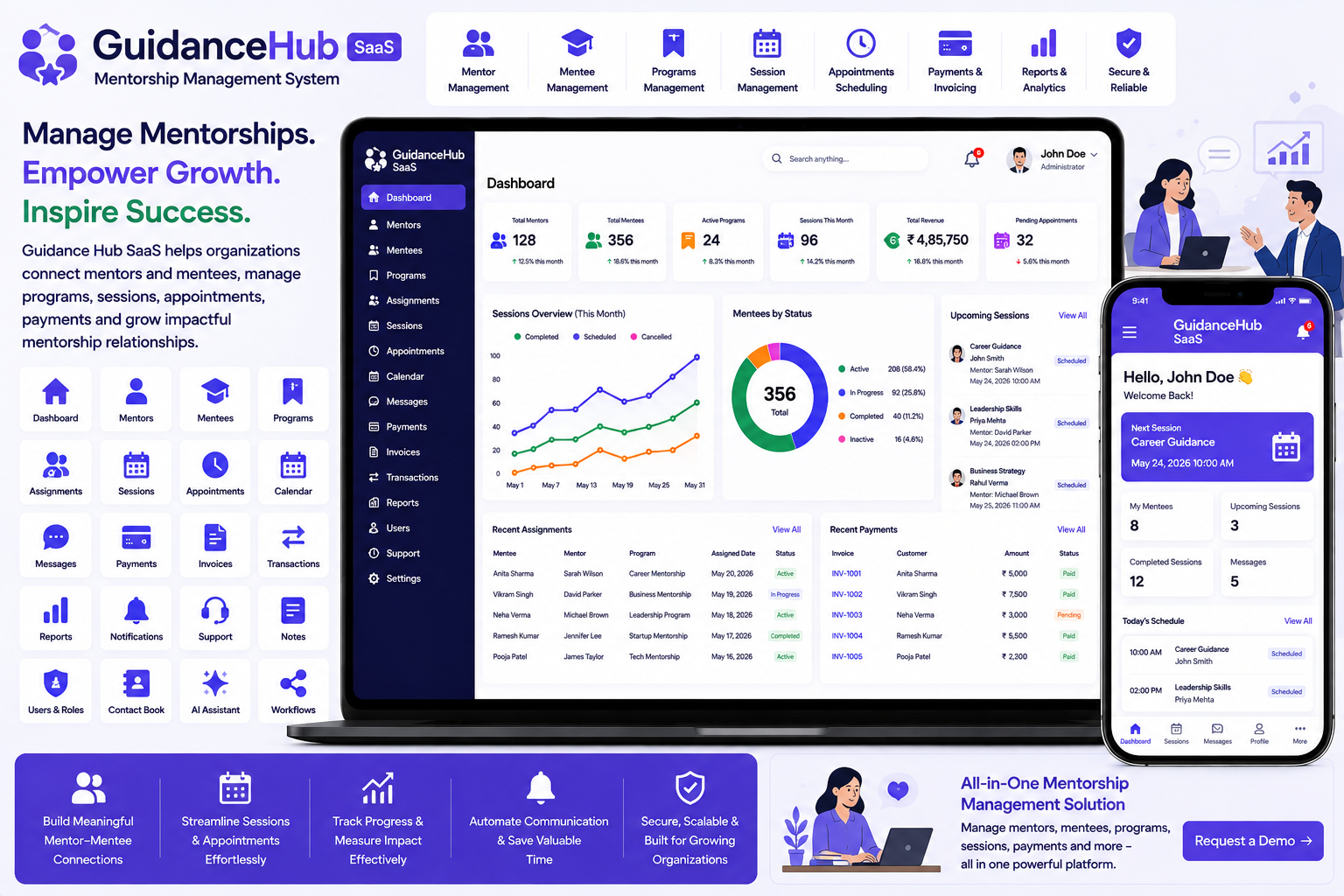
Guidance Hub SaaS – Mentorship Management System
What Is a Mentorship Management System?
A Mentorship Management System is software designed to help organizations manage mentors, mentees, mentorship programs, sessions, appointments, communication, payments, and related activities from one centralized platform.
A typical mentorship workflow can look like:
Mentor Registration → Mentee Registration → Program Selection → Mentor Assignment → Session Scheduling → Mentorship → Progress Tracking → Feedback
Instead of using spreadsheets, emails, messaging apps, and separate calendars, organizations can manage the mentorship process digitally.
Why Do Organizations Need Mentorship Management Software?
Managing a mentorship program manually can create several challenges.
Common problems include:
- Difficulty managing mentor profiles
- Unorganized mentee information
- Manual mentor-mentee matching
- Scheduling conflicts
- Missed sessions
- Poor communication
- Difficult payment tracking
- Lack of program visibility
- Manual reporting
- Difficulty tracking mentorship progress
A centralized mentorship platform can help organizations create a more structured and efficient mentorship experience.
Key Features of a Mentorship Management System
1. Informative Dashboard
A centralized dashboard provides an overview of mentorship activities.
Administrators can monitor information such as:
- Mentors
- Mentees
- Programs
- Sessions
- Appointments
- Payments
- Transactions
- Reports
- Users
A dashboard allows administrators to understand the overall status of their mentorship platform quickly.
2. Mentor Management
Mentors are at the center of any mentorship platform.
A mentor profile can contain:
- Name
- Contact Information
- Professional Experience
- Skills
- Expertise
- Availability
- Mentorship Programs
- Sessions
- Appointments
A centralized mentor database makes it easier to find and manage suitable mentors.
3. Mentee Management
Mentees need a structured profile containing relevant information.
A mentee record can include:
- Name
- Contact Information
- Learning Goals
- Interests
- Skills
- Selected Programs
- Assigned Mentor
- Sessions
- Progress Information
This allows organizations to maintain a complete view of each mentee.
4. Mentorship Program Management
Organizations may offer multiple mentorship programs.
Examples include:
- Career Mentorship
- Business Mentorship
- Startup Mentorship
- Leadership Mentorship
- Student Mentorship
- Technology Mentorship
- Professional Development
- Personal Development
Program management allows administrators to define and organize different mentorship offerings.
5. Mentor-Mentee Assignment
One of the most important parts of a mentorship platform is connecting mentors with suitable mentees.
A structured assignment process can consider:
- Skills
- Expertise
- Goals
- Industry
- Experience
- Availability
- Program
For example:
Mentee Goal: Learn Digital Marketing
Required Expertise: SEO + Social Media Marketing
Assigned Mentor: Digital Marketing Specialist
This can create more meaningful mentorship relationships.
6. Session Management
Mentorship often takes place through scheduled sessions.
Session management can help track:
- Mentor
- Mentee
- Date
- Time
- Program
- Session Status
- Notes
- Meeting Details
This gives both administrators and participants better visibility into upcoming sessions.
7. Appointment Management
Mentors and mentees may need to schedule appointments based on their availability.
An appointment system can help manage:
- Available Time Slots
- Mentor
- Mentee
- Appointment Date
- Appointment Time
- Status
- Notes
This reduces scheduling conflicts and makes the booking process more organized.
8. Mentorship Calendar
A calendar provides a visual overview of mentorship activities.
Users can monitor:
- Upcoming Sessions
- Mentor Appointments
- Mentee Meetings
- Program Events
- Scheduled Activities
A calendar can help mentors manage their time more efficiently.
9. Mentor Dashboard
A dedicated mentor dashboard gives mentors access to the information relevant to their work.
Mentors can potentially view:
- Assigned Mentees
- Upcoming Sessions
- Appointments
- Programs
- Payments
- Notifications
- Account Information
A dedicated dashboard keeps mentor workflows separate from administrative functions.
10. Mentee Dashboard
A mentee dashboard provides participants with access to their mentorship activities.
Mentees can potentially view:
- Assigned Mentor
- Mentorship Program
- Upcoming Sessions
- Appointments
- Progress
- Notifications
- Account Details
This improves transparency and provides a better participant experience.
11. Customer/User Management
Mentorship platforms may serve different types of users.
For example:
- Super Admin
- Program Administrator
- Mentor
- Mentee
- Staff
User management allows administrators to create and maintain user accounts.
12. Roles & Permissions
Different users require different levels of access.
For example:
Administrator: Manage the complete platform.
Mentor: Manage assigned mentees and sessions.
Mentee: Access their mentor and scheduled sessions.
Role-based permissions help protect sensitive information and keep workflows organized.
13. Payment Management
Some mentorship programs are paid.
Payment management can help track:
- Program Fees
- Session Fees
- Mentor Payments
- Customer Payments
- Payment Date
- Payment Status
- Payment Method
This provides better financial visibility for mentorship organizations.
14. Invoice Management
Paid mentorship programs may need to issue invoices.
Invoices can include:
- Customer
- Program
- Service
- Session
- Amount
- Tax
- Discount
- Total
- Payment Status
Digital invoice management makes it easier to maintain financial records.
15. Transaction Management
A mentorship platform can have multiple financial transactions.
Transaction management helps maintain records related to:
- Payments
- Refunds
- Program Fees
- Mentor Payments
- Subscription Transactions
This provides a centralized financial history.
16. Income Management
Mentorship organizations may generate income through:
- Mentorship Programs
- Individual Sessions
- Memberships
- Workshops
- Consulting
- Training Programs
Income management helps businesses track revenue generated through different services.
17. Expense Management
Mentorship businesses may have operating expenses such as:
- Mentor Payments
- Marketing
- Software
- Office Expenses
- Events
- Training Materials
- Administrative Costs
Expense management helps organizations maintain accurate financial records.
18. Income vs Expense Reporting
Understanding financial performance is important for paid mentorship programs.
Businesses can compare:
Total Income − Total Expenses = Operating Result
Financial reports can help program administrators understand costs, revenue, and profitability.
19. Mentorship Reports
Reports can provide valuable insights into program performance.
Useful reports may include:
- Mentor Reports
- Mentee Reports
- Program Reports
- Session Reports
- Appointment Reports
- Payment Reports
- Income Reports
- Expense Reports
These insights can help organizations improve their mentorship programs.
20. Email Notifications
Mentorship programs require regular communication.
Email notifications can be used for:
- Mentor Registration
- Mentee Registration
- Session Confirmation
- Appointment Updates
- Payment Confirmation
- Program Notifications
- Account Notifications
Automated email notifications can reduce manual follow-up work.
21. SMS Notifications
SMS can be useful for important or time-sensitive mentorship notifications.
Potential uses include:
- Session Reminders
- Appointment Notifications
- Payment Updates
- Program Alerts
- Account Notifications
This provides an additional communication channel for mentors and mentees.
22. WhatsApp Notifications
WhatsApp can provide a convenient way to communicate with mentors and mentees.
Potential uses include:
- Session Reminders
- Appointment Updates
- Program Notifications
- Payment Notifications
- General Communication
This can improve communication speed and convenience.
23. Contact Management
Mentorship organizations interact with many people.
Contact management can help maintain information about:
- Mentors
- Mentees
- Program Partners
- Organizations
- Coaches
- Staff
- Other Business Contacts
Keeping contacts in one place makes communication easier.
24. Notes Management
Mentorship programs may require additional notes about participants or sessions.
Examples include:
- Session Notes
- Mentor Feedback
- Mentee Goals
- Follow-Up Actions
- Program Notes
- Internal Administrative Notes
A notes system helps keep important information connected with the appropriate record.
25. Support System
Mentorship platforms may need to provide support to mentors and mentees.
A support system can help manage:
- Technical Questions
- Program Questions
- Payment Issues
- Scheduling Problems
- Account Issues
- General Support Requests
This provides a structured way to handle participant support.
26. OpenAI Integration
Artificial intelligence can provide opportunities for mentorship platforms to automate repetitive tasks.
AI-assisted workflows can potentially help with:
- Generating program descriptions
- Creating mentorship content
- Preparing session summaries
- Drafting communications
- Generating learning resources
- Creating FAQs
AI should be used responsibly, especially when processing participant information.
27. n8n Workflow Automation
Mentorship organizations may use other tools for communication, CRM, calendars, marketing, and reporting.
n8n can help connect different applications and automate workflows.
For example:
New Mentee Registration → CRM → Email → Mentor Assignment Notification
Or:
Session Completed → Generate Summary → Save Record → Send Follow-Up
Workflow automation can reduce repetitive administrative work.
28. Payment Gateway Integration
Paid mentorship platforms may need online payment processing.
Depending on the configuration, payment gateways can allow users to pay for:
- Mentorship Programs
- Sessions
- Subscriptions
- Coaching Services
Online payment support can make registration more convenient.
29. SaaS Subscription Management
A mentorship platform can also be operated as a SaaS business.
For example, software providers can offer different subscription plans to:
- Coaches
- Mentorship Organizations
- Educational Institutions
- Training Companies
- Professional Networks
Subscription management allows administrators to create pricing plans and manage customer subscriptions.
30. Subscription Coupon Management
Promotional coupons can help SaaS providers attract new mentorship businesses.
Examples include:
- New Customer Discount
- Launch Offer
- Annual Plan Discount
- Seasonal Promotion
Coupon management can help SaaS businesses run marketing campaigns.
31. Dynamic Landing Page CMS
A SaaS mentorship platform needs a professional website to attract mentors, coaches, and organizations.
A dynamic landing page CMS allows administrators to manage:
- Homepage
- Features
- Pricing
- Testimonials
- FAQs
- Contact Information
This allows marketing teams to update the website without changing the core application.
32. SEO Settings
SEO can help mentorship platforms attract organizations and users through search engines.
SEO settings can help manage:
- Meta Titles
- Meta Descriptions
- SEO Content
- Social Sharing Information
- Search Engine Settings
A strong SEO strategy can support long-term organic growth.
33. Multi-Language Support
Mentorship programs can operate across different regions.
Multi-language support allows users to interact with the platform in their preferred language.
This can make the system more suitable for international mentorship programs.
34. RTL & LTR Support
If the platform serves right-to-left language markets, RTL support becomes important.
Supporting both RTL and LTR interfaces makes the platform more flexible for international users.
35. Two-Factor Authentication
Mentorship platforms can contain personal information, communication records, and payment data.
Two-factor authentication provides an additional layer of security for user accounts.
Benefits of Mentorship Management Software
Improve Mentor & Mentee Organization
Centralized profiles make it easier to manage mentors, mentees, and their relationships.
Simplify Scheduling
Session and appointment management help reduce scheduling conflicts.
Improve Participant Experience
Mentors and mentees can access relevant information from dedicated dashboards.
Reduce Administrative Work
Digital registration, scheduling, notifications, and reporting reduce repetitive manual tasks.
Improve Program Visibility
Administrators can monitor mentorship programs, sessions, and participant activity.
Improve Financial Management
Payments, invoices, income, expenses, and transactions can be managed centrally.
Improve Communication
Email, SMS, and WhatsApp notifications provide multiple communication channels.
Support Business Growth
SaaS subscription functionality allows providers to offer mentorship management software to multiple organizations.
Who Can Use a Mentorship Management System?
A Mentorship Management System can be useful for:
- Mentorship Organizations
- Coaching Businesses
- Career Coaching Companies
- Educational Institutions
- Universities
- Colleges
- Training Institutes
- Professional Associations
- Startup Accelerators
- Incubators
- Corporate Mentorship Programs
- Leadership Development Programs
- Business Coaching Programs
- Youth Development Organizations
- Online Mentorship Platforms
How to Choose the Best Mentorship Management Software
Before selecting a mentorship platform, consider:
- Mentor Management
- Mentee Management
- Mentorship Programs
- Mentor-Mentee Assignment
- Session Management
- Appointment Management
- Calendar Management
- Mentor Dashboard
- Mentee Dashboard
- User Management
- Roles & Permissions
- Payment Management
- Invoice Management
- Transaction Management
- Income Management
- Expense Management
- Reports
- Email Notifications
- SMS Notifications
- WhatsApp Notifications
- Contact Management
- Notes Management
- Support System
- AI Integration
- Workflow Automation
- Payment Gateways
- SaaS Subscription Management
- Coupon Management
- Multi-Language Support
- RTL/LTR Support
- Security Features
- SEO Settings
The best mentorship software should make it easier for administrators, mentors, and mentees to manage their respective responsibilities.
Why Choose Guidance Hub SaaS?
If you're looking for a ready-to-use Mentorship Management System, Guidance Hub SaaS by Smartweb Infotech provides a foundation for managing mentorship programs, mentors, mentees, sessions, appointments, users, payments, and other business operations.
It can be suitable for organizations and entrepreneurs who want to digitize their mentorship workflow or launch a mentorship management SaaS platform.
Key Areas to Look For
- Informative Dashboard
- Mentor Management
- Mentee Management
- Mentorship Program Management
- Mentor-Mentee Assignment
- Session Management
- Appointment Management
- Calendar Management
- Mentor Dashboard
- Mentee Dashboard
- User Management
- Roles & Permissions
- Payment Management
- Invoice Management
- Transaction Management
- Income Management
- Expense Management
- Reports
- Email Notifications
- SMS Notifications
- WhatsApp Notifications
- Contact Management
- Notes Management
- Support System
- AI Integration
- n8n Workflow Automation
- Payment Gateway Support
- SaaS Subscription Management
- Subscription Coupons
- Dynamic Landing Page CMS
- SEO Settings
- Multi-Language Support
- RTL/LTR Support
- Two-Factor Authentication
Mentorship Management Software for Growing Organizations
A small mentorship program may initially manage mentors and mentees using spreadsheets, email, WhatsApp, and Google Calendar.
As the program grows, however, these tools can become difficult to coordinate.
A digital mentorship platform can transform:
Spreadsheet → Centralized Mentor & Mentee Management
Email Scheduling → Digital Appointment Management
Manual Mentor Assignment → Structured Mentor-Mentee Management
Personal Calendar → Mentorship Calendar
Manual Session Tracking → Digital Session Management
Paper Payment Records → Digital Payment Management
Separate Financial Sheet → Income & Expense Management
Manual Reports → Mentorship Reports
Manual Follow-Up → Automated Notifications
This can help mentorship organizations spend less time managing administration and more time focusing on participant development.
Frequently Asked Questions
What is a Mentorship Management System?
A Mentorship Management System is software that helps organizations manage mentors, mentees, programs, sessions, appointments, payments, communication, and mentorship activities.
Can I manage mentors and mentees?
Yes. A centralized mentorship platform can maintain profiles and information for both mentors and mentees.
Can I assign mentors to mentees?
Yes. Mentor-mentee assignment helps organizations connect participants based on program requirements, expertise, goals, and availability.
Can I manage mentorship sessions?
Yes. Session management allows administrators and participants to organize scheduled mentorship meetings.
Can mentors manage their own schedules?
A mentor dashboard and appointment/calendar functionality can help mentors manage their assigned activities and availability.
Can mentees access their mentorship information?
A dedicated mentee dashboard can provide participants with access to their mentor, programs, sessions, appointments, and other relevant information.
Can I manage paid mentorship programs?
Yes. Payment, invoice, transaction, income, and expense management can support paid mentorship operations.
Can I send session reminders?
Email, SMS, and WhatsApp integrations can provide different channels for sending session and appointment notifications, depending on the configured integrations.
Can I use AI in mentorship management?
AI can assist with tasks such as content generation, session summaries, communication drafts, and learning resources when properly configured.
Can I automate mentorship workflows?
Yes. Workflow automation tools such as n8n can connect the mentorship platform with other applications and automate repetitive processes.
Can I offer mentorship management software as SaaS?
Yes. A SaaS-enabled mentorship platform can allow software providers to offer subscription plans to coaches, educational organizations, mentorship companies, and other businesses.
Final Thoughts
Effective mentorship requires strong coordination between mentors, mentees, administrators, and program managers. As the number of participants and sessions increases, managing everything through spreadsheets, email, and messaging applications can become increasingly difficult.
A modern Mentorship Management System brings important workflows into one centralized platform—from mentor and mentee management to programs, assignments, sessions, appointments, payments, communication, and reporting.
For mentorship organizations, coaching businesses, educational institutions, corporate mentorship programs, accelerators, and entrepreneurs looking to launch a mentorship SaaS platform, Guidance Hub SaaS – Mentorship Management System provides a foundation for digitizing mentorship operations.
Comments (0)