
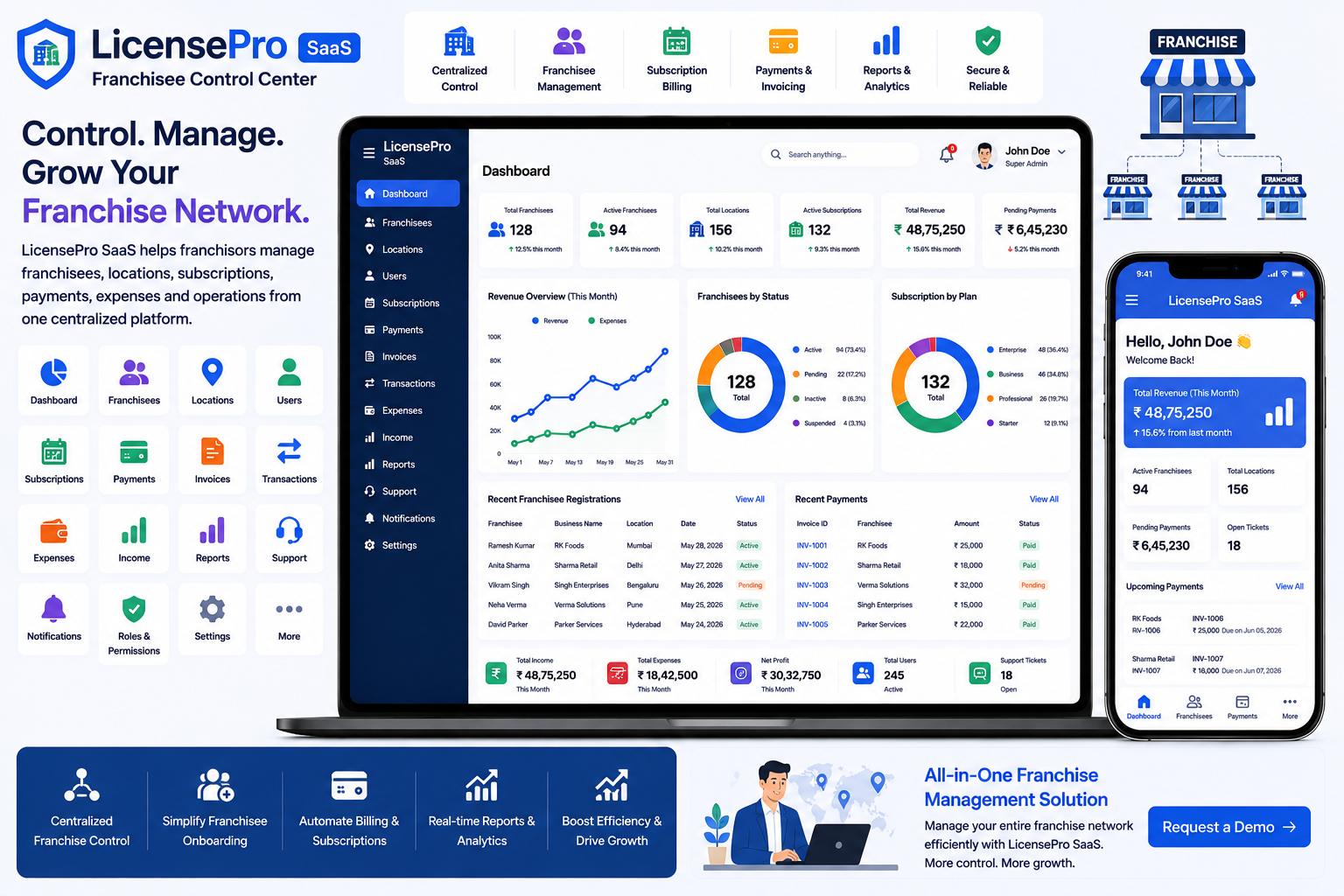
Looking for a ready-made solution?
👉Franchisee Control Center
https://smartwebinfotech.com/items/licensepro-saas-franchisee-control-center/1026
Managing a franchise business is more complex than managing a single location. Franchise owners need to coordinate multiple branches, franchisees, employees, customers, sales, payments, expenses, operations, and reporting while maintaining consistent business processes across locations.
As a franchise network grows, spreadsheets, emails, phone calls, and disconnected systems can make it difficult for the franchisor to maintain visibility and control.
A Franchisee Control Center provides a centralized digital platform for managing franchise operations, franchisees, locations, subscriptions, payments, communication, and business performance.
In this guide, we'll explore what Franchise Management Software is, its key features, benefits, use cases, and how LicensePro SaaS – Franchisee Control Center can help businesses manage franchise operations more efficiently.
LicensePro SaaS – Franchisee Control Center
What Is a Franchisee Control Center?
A Franchisee Control Center is a centralized management system that helps franchisors manage their franchise network from one platform.
It can provide a single place to manage:
- Franchisees
- Branches
- Users
- Business information
- Subscriptions
- Payments
- Invoices
- Expenses
- Transactions
- Notifications
- Reports
- System settings
A typical franchise management workflow can look like:
Franchise Registration → Approval → Location Setup → Subscription → Operations → Sales & Payments → Reporting → Performance Monitoring
Instead of maintaining separate spreadsheets for every franchise location, a centralized system can provide better visibility across the entire franchise network.
Why Do Franchise Businesses Need Management Software?
Franchise businesses often operate across multiple locations.
For example, a franchise network may have:
- 5 Locations
- 20 Locations
- 100+ Locations
- Different Franchise Owners
- Multiple Employees
- Different Branch Managers
- Centralized Administration
Managing these locations manually can create several challenges:
- Difficulty monitoring franchisees
- Inconsistent operational processes
- Duplicate data
- Manual reporting
- Payment tracking issues
- Subscription management problems
- Poor communication
- Difficulty monitoring branch performance
- Limited centralized control
A Franchise Management System can help franchisors centralize information and improve operational visibility.
Key Features of a Franchisee Control Center
1. Centralized Dashboard
A franchise dashboard provides management with an overview of the entire franchise network.
Important information may include:
- Total Franchisees
- Active Franchisees
- Locations
- Users
- Subscriptions
- Payments
- Invoices
- Expenses
- Transactions
- Reports
A centralized dashboard helps franchisors understand overall business activity without checking every branch individually.
2. Franchisee Management
Franchisee management is one of the core functions of a franchise control system.
A franchisee profile can include:
- Franchisee Name
- Business Name
- Contact Details
- Location
- Subscription
- Payment Information
- Branch Information
- Status
- Account Information
This provides a centralized database of all franchise partners.
3. Franchise Location Management
Franchise businesses can operate across multiple cities and regions.
Location management can maintain:
- Branch Name
- Address
- City
- State
- Country
- Contact Information
- Franchisee
- Branch Status
- Business Information
This makes it easier for franchisors to understand their complete branch network.
4. Franchise Registration
A digital registration process can simplify onboarding new franchisees.
A registration workflow may include:
Application → Verification → Approval → Account Creation → Subscription → Branch Setup
Digital onboarding reduces paperwork and can help standardize the franchise registration process.
5. Franchisee Account Management
Each franchisee may require an individual account to access the platform.
The account can provide access to relevant:
- Business Information
- Branch Data
- Employees
- Transactions
- Payments
- Reports
- Settings
This allows franchisees to manage their own operational information while the franchisor maintains centralized oversight.
6. User Management
Franchise operations can involve different types of users.
Examples include:
- Super Admin
- Franchisor
- Franchisee
- Branch Manager
- Employee
- Accountant
User management allows administrators to create and manage accounts for different users.
7. Roles & Permissions
Different users should have different access levels.
For example:
Super Admin: Complete platform access.
Franchisor: Manage franchise network.
Franchisee: Manage assigned branch/business information.
Branch Manager: Manage branch-level activities.
Employee: Access assigned operational features.
Role-based permissions help protect sensitive business information.
8. Subscription Management
If the franchise management platform is offered as SaaS, subscription management becomes an important feature.
Administrators can create different subscription plans based on:
- Number of Users
- Features
- Locations
- Duration
- Business Requirements
For example:
Starter Plan
For small franchise operations.
Professional Plan
For growing franchise networks.
Enterprise Plan
For larger franchise organizations.
9. Subscription Payment Management
Franchisees may need to pay recurring subscription fees.
Payment management can help track:
- Subscription
- Payment Amount
- Payment Date
- Payment Method
- Payment Status
- Renewal Date
This makes recurring franchise software billing easier to manage.
10. Invoice Management
Invoices can be generated for franchise-related payments and subscriptions.
An invoice can contain:
- Franchisee
- Subscription Plan
- Billing Period
- Amount
- Tax
- Discount
- Total
- Payment Status
Digital invoices provide better financial record keeping.
11. Transaction Management
Franchise networks can generate many financial transactions.
Transaction management can help record:
- Subscription Payments
- Franchise Fees
- Service Charges
- Other Payments
- Refunds
- Adjustments
Centralized transaction records make financial monitoring easier.
12. Expense Management
Franchise operations can involve various expenses.
Examples include:
- Marketing
- Office Expenses
- Technology
- Staff Costs
- Maintenance
- Travel
- Equipment
- Operational Expenses
Expense management allows businesses to organize and track these costs.
13. Income Management
A franchise business can generate income from different sources.
Examples include:
- Franchise Fees
- Subscription Fees
- Service Fees
- Product Sales
- Royalty Payments
- Other Business Income
Income management helps businesses maintain organized revenue records.
14. Income vs Expense Reports
Franchisors need financial visibility across their network.
An income-versus-expense report can help compare:
Total Income − Total Expenses = Operating Result
These reports can help management understand financial performance and identify areas requiring attention.
15. Franchise Performance Reports
Reports can provide valuable information about franchise operations.
Useful reports may include:
- Franchisee Reports
- Branch Reports
- Subscription Reports
- Payment Reports
- Invoice Reports
- Expense Reports
- Income Reports
- Transaction Reports
This helps management make data-driven decisions.
16. Franchisee Dashboard
A dedicated franchisee dashboard can provide business owners with access to their own information.
Franchisees can potentially view:
- Business Overview
- Branch Information
- Employees
- Transactions
- Payments
- Invoices
- Expenses
- Reports
- Notifications
This gives franchisees operational visibility while maintaining centralized platform control.
17. Notifications
A franchise network requires consistent communication between franchisors and franchisees.
Notifications can be used for:
- Subscription Renewal
- Payment Confirmation
- Account Updates
- System Announcements
- Important Business Information
- Administrative Messages
Automated notifications can reduce manual communication.
18. Email Notifications
Email remains an important communication channel for franchise businesses.
Email notifications can be used for:
- Franchise Registration
- Account Activation
- Payment Confirmation
- Invoice Delivery
- Subscription Renewal
- System Updates
Email templates can help standardize franchise communication.
19. SMS Notifications
SMS can be useful for time-sensitive franchise updates.
Examples include:
- Payment Reminders
- Subscription Expiration
- Account Alerts
- Important Announcements
SMS notifications can provide franchisees with quick access to important information.
20. WhatsApp Notifications
WhatsApp can provide another convenient communication channel for franchise networks.
Businesses can potentially use WhatsApp notifications for:
- Payment Updates
- Subscription Reminders
- Account Notifications
- Franchise Announcements
- Important Alerts
This can make communication faster and more convenient.
21. Contact Management
Franchise organizations communicate with:
- Franchisees
- Branch Managers
- Employees
- Vendors
- Partners
- Customers
- Business Contacts
A centralized contact management system helps keep this information organized.
22. Notes Management
Franchise management often requires keeping additional notes.
Examples include:
- Franchise Discussions
- Branch Requirements
- Meeting Notes
- Operational Instructions
- Follow-Up Actions
- Internal Management Notes
A notes system can keep important information connected to franchise records.
23. Support System
Franchisees may need help from the central administration.
A support system can manage:
- Technical Issues
- Account Problems
- Payment Questions
- Subscription Issues
- Operational Requests
- General Support Tickets
This provides a structured communication channel between franchisees and the central team.
24. Franchise Onboarding
Franchise onboarding is an important part of building a successful franchise network.
A digital onboarding workflow can help standardize:
- Franchise Application
- Verification
- Approval
- Agreement
- Account Creation
- Subscription
- Location Setup
- Training
- Business Launch
Standardized onboarding can help reduce administrative work.
25. Centralized Franchise Control
One of the biggest advantages of a Franchisee Control Center is centralized management.
The franchisor can have a single platform for managing the network rather than maintaining separate systems for every franchisee.
This can improve:
- Visibility
- Communication
- Reporting
- Data Organization
- Financial Monitoring
- Administrative Efficiency
26. SaaS Business Model
A Franchisee Control Center can also be operated as a SaaS business.
A software provider can offer the platform to different franchise businesses through monthly or annual subscription plans.
For example:
Basic → Professional → Business → Enterprise
Subscription-based software provides recurring revenue opportunities for SaaS providers.
27. Subscription Coupon Management
Promotional discounts can help SaaS businesses attract new franchise customers.
Examples include:
- New Customer Discount
- Annual Plan Discount
- Launch Offer
- Seasonal Promotion
- Referral Discount
Coupon management can support marketing campaigns.
28. Payment Gateway Integration
Online payment gateways can make it easier for franchisees to pay subscription fees and other charges.
Depending on the configured platform, payment gateways can support online transactions for:
- Subscriptions
- Franchise Fees
- Services
- Invoices
Online payment options can improve the overall billing experience.
29. Dynamic Landing Page CMS
A franchise SaaS platform needs a professional public website to attract potential customers.
A dynamic landing page CMS can help administrators manage:
- Homepage
- Features
- Pricing
- Testimonials
- FAQs
- Contact Pages
This allows businesses to update website content without changing the application's source code.
30. SEO Settings
SEO can help franchise management software attract customers through search engines.
SEO settings can help manage:
- Meta Titles
- Meta Descriptions
- SEO Content
- Social Sharing Information
- Search Engine Settings
A strong SEO strategy can help SaaS businesses generate organic traffic.
31. Multi-Language Support
Franchise networks can operate across different countries and regions.
Multi-language support can make the platform more accessible to international franchisees.
This can be particularly useful for SaaS businesses targeting global markets.
32. RTL & LTR Support
International franchise platforms may need to support both left-to-right and right-to-left languages.
RTL/LTR support makes the system more flexible for different markets.
33. Two-Factor Authentication
Franchise management platforms can contain sensitive business, financial, and user information.
Two-factor authentication adds an additional layer of account security.
It can help protect administrator and franchisee accounts from unauthorized access.
Benefits of Franchise Management Software
Centralized Control
Manage franchisees, branches, users, subscriptions, and financial information from one platform.
Better Franchisee Visibility
Get a clearer overview of franchise network activity.
Standardized Processes
Create consistent workflows for onboarding, billing, communication, and administration.
Improved Communication
Use email, SMS, WhatsApp, and support tools to communicate with franchisees.
Better Financial Management
Track subscriptions, invoices, payments, income, expenses, and transactions.
Reduced Administrative Work
Automate repetitive franchise management activities.
Improved Reporting
Generate reports to understand franchise network performance.
Scalable Franchise Operations
A centralized system can support growing numbers of franchisees and locations.
Who Can Use a Franchisee Control Center?
Franchise management software can be useful for:
- Restaurant Franchises
- Retail Franchises
- Education Franchises
- Fitness Franchises
- Salon Franchises
- Cleaning Franchises
- Service Franchises
- Healthcare Franchises
- Automotive Franchises
- Real Estate Franchises
- Food & Beverage Franchises
- Training Institutes
- Consultancy Franchises
- Multi-Location Businesses
- Franchise Networks
How to Choose the Best Franchise Management Software
Before selecting a franchise management platform, consider:
- Franchisee Management
- Location Management
- Franchise Registration
- User Management
- Roles & Permissions
- Franchisee Dashboard
- Subscription Management
- Payment Management
- Invoice Management
- Transaction Management
- Income Management
- Expense Management
- Financial Reports
- Franchise Reports
- Email Notifications
- SMS Notifications
- WhatsApp Notifications
- Contact Management
- Notes Management
- Support System
- Franchise Onboarding
- Payment Gateways
- Subscription Coupons
- Dynamic Landing Page CMS
- SEO Settings
- Multi-Language Support
- RTL/LTR Support
- Two-Factor Authentication
- Security Features
The best solution should provide centralized control for the franchisor while giving franchisees enough access to manage their own business operations.
Why Choose LicensePro SaaS?
If you're looking for a Franchisee Control Center, LicensePro SaaS by Smartweb Infotech provides a foundation for managing franchise-related business operations through a centralized platform.
It can help businesses organize franchisees, users, subscriptions, payments, invoices, expenses, transactions, communication, and other administrative activities.
Key Areas to Look For
- Informative Dashboard
- Franchisee Management
- User Management
- Roles & Permissions
- Franchisee Dashboard
- Subscription Management
- Payment Management
- Invoice Management
- Transaction Management
- Income Management
- Expense Management
- Reports & Analytics
- Email Notifications
- SMS Notifications
- WhatsApp Notifications
- Contact Management
- Notes Management
- Support System
- Payment Gateway Integration
- Subscription Coupons
- Dynamic Landing Page CMS
- SEO Settings
- Multi-Language Support
- RTL/LTR Support
- Two-Factor Authentication
Franchise Management Software for Growing Networks
A small franchise network may initially manage franchisees through spreadsheets, email, WhatsApp, and accounting software.
As the network grows, however, managing dozens or hundreds of franchise locations manually can become difficult.
A digital franchise management platform can transform:
Spreadsheet Franchise List → Centralized Franchisee Management
Manual Branch Records → Location Management
Email Communication → Centralized Notifications
Manual Subscription Tracking → Subscription Management
Paper Invoices → Digital Invoice Management
Bank Statement Checking → Payment & Transaction Management
Separate Expense Sheets → Expense Management
Manual Franchise Reports → Centralized Reporting
Manual Support Emails → Support Ticket Management
This can help franchisors maintain better visibility and provide franchisees with a more organized digital experience.
Frequently Asked Questions
What is a Franchisee Control Center?
A Franchisee Control Center is software that helps franchisors manage franchisees, locations, users, subscriptions, payments, invoices, expenses, communication, and franchise operations from a centralized platform.
Can I manage multiple franchisees?
Yes. A centralized franchise management platform is designed to organize multiple franchisees and their related information.
Can franchisees have their own accounts?
Yes. Franchisee accounts can provide individual access to relevant business information and platform features.
Can I manage franchise subscriptions?
Yes. SaaS subscription management can help administrators create plans, manage subscriptions, track payments, and handle renewals.
Can I manage franchise payments?
Yes. Payment and transaction management can help maintain records of subscription payments, fees, and other financial transactions.
Can I generate invoices?
Yes. Invoice management can help businesses create and maintain billing records.
Can I track franchise expenses?
Yes. Expense management can help organize franchise-related costs and operational expenses.
Can franchisees access a dashboard?
A dedicated franchisee dashboard can provide franchise owners with access to their business information, payments, subscriptions, reports, and other permitted features.
Can I send notifications to franchisees?
Email, SMS, and WhatsApp integrations can provide multiple communication channels for franchise notifications, depending on the configured integrations.
Can I offer franchise management software as SaaS?
Yes. A SaaS-enabled Franchisee Control Center can allow software providers to offer subscription-based franchise management software to businesses.
Final Thoughts
Managing a growing franchise network requires centralized control, consistent processes, effective communication, and accurate financial information.
As the number of franchisees and locations increases, spreadsheets and disconnected tools can make franchise management increasingly difficult.
A modern Franchisee Control Center can bring important operations into one centralized platform—from franchisee management and location administration to subscriptions, payments, invoices, expenses, transactions, communication, and reporting.
For franchisors, multi-location businesses, franchise networks, and entrepreneurs looking to offer franchise management software as SaaS, LicensePro SaaS – Franchisee Control Center provides a foundation for digitizing franchise administration.
Comments (0)